CyberSecurity For Business

Every business has a sales strategy, but not all have a cybersecurity strategy — especially small to medium businesses.Only 53% of companies with fewer than 50 employees put a priority on cybersecurity. There are some reasons for this neglect:

  • Overall lack of education about how dangerous cyberattacks can be
  • Smaller businesses feel that because of their size, they won’t be targeted
  • Many businesses don’t even realize they’ve been compromised—because the stolen information is being used for a larger scheme involving multiple targets (55% of attacks go unnoticed initially)
  • Financial cost of a cybersecurity solution

Businesses are playing a dangerous game with this approach. There is a cyberattack globally every 39 seconds — and 43% of these are against small businesses. Financially, these attacks cost companies an average of $200,000, which is enough to sink many small businesses immediately. Besides the immediate monetary cost of an attack or breach, there are other serious consequences to consider — Loss or damage to electronic data, lawsuits if consumer information is stolen, and irreparable damage to a company’s reputation that could deter potential future customers. Cybersecurity should not be looked upon as an extra or optional expense for a company, but as a key pillar to any company’s foundation before beginning operations. Furthermore, during the current COVID-19 pandemic, there has been a 37% increase in overall cyberattacks — These can be particularly devastating at a time when small businesses are financially struggling already due to the pandemic.

security

Many large businesses may have in-house cybersecurity to deal with threats in the office, however, one of the largest growing cyber threats against any business is being created by the inherit vulnerability of Bring Your Own Device, or “BYOD” culture. Previously much of this came in the form of employee mobile devices; a worker may have access to mobile documents or business email accounts on their phone. Mobile services and smartphone functionalities are rapidly expanding, and with that comes the expansion of the sophistication and volume of cyberattacks against them. Despite having previously mentioned in-house security, the corporate sector is still a long way from coming to grips with rapidly expanding mobile security exposures. This issue has become intensified with the COVID-19 pandemic — Not only are employee mobile devices at risk, many are now working from home on their own laptop or desktop accessing sensitive business systems on entirely unsecured networks. Together, all these factors have created a cyberattack “perfect storm” on the business sector, that will wreak havoc for a very long time.

cybersecurity solution

SaferNet is the perfect solution to the cybersecurity issues that businesses face today. It not only connects every device using a secure, 24/7 always on, military grade VPN, but it also stops outside cyberthreats, malware and viruses as well. On SaferNet, all employees are fully protected anywhere in the world, all the time, on any cellular or Wi-Fi network. In addition to SaferNet’s VPN andcyber protection, it also offers a range of employee controls including internet filtering, monitoring, scheduling, and blocking access to websites or even entire website categories. Typically, a business would need 3 separate services for a VPN, Malware Protection, and Internet Controls; SaferNet offers all 3 features in one service.

SaferNet truly is an endpoint security presence that can be implemented in minutes around the world, on phones, laptops, tablets, and computers at an economical price point that caters to all size of businesses. SaferNet guarantees a smooth setup and installation process that takes only minutes, and an easily accessible control hub for you to monitor your all employee’s devices; including activity, time spent online, and threats blocked.

Protect your business and employees with SaferNettoday, and have peace of mind that your online and network safety is assured.

Deadliest Cyberattack

“2020 was the year in which the world was gripped by a global pandemic.” Rightfully, this was the top story of nearly all news and media reports. Buried underneath the stories and numbers of a physical pandemic, were the reports of a digital pandemic. The correlation between these two types of pandemics is easy to see in hindsight; a global workforce leaving their office, and the cybersecurity it had provided, to work from home on their own devices and with their own cybersecurity, (or lack thereof). On a consumer level, there has been a 51% increase in global cyberattacks since 2019, and 2020 became ‘the worst year on record’ for data breaches. This dramatic increase in attacks, while remarkable, was not unforeseen in the cybersecurity world at the start of the pandemic. When the first waves of office workers made their initial exodus to turn their homes into impromptu offices, experts and leaders in the cybersecurity industry warned of the dangers of working from home without appropriate cybersecurity. They warned that the “bring-your-own-device” approach many companies were taking would make working from home dangerous without the correct in-house security one would expect to find in any business.

The digital breaches experienced during the transition of employees to working from home was not the biggest cybersecurity news of the year, however. In recent days, it has come to light that the US government has witnessed its single biggest cyberattack in history, with many of the details yet to unfold. The attack, which was carried out by state-sponsored hackers, is believed to have started as far back as March, but was only detected a week ago. It is now known that in March, the hackers breached and gained access to SolarWinds, a Texas-based IT and network management company. SolarWinds provides a number of tools, one of which is the Orion network monitoring tool. Orion is used by many companies including Deloitte, Intel, Nvidia, VMware and also a number of governments, chiefly the US and UK governments. Orion, once breached by the hackers, gave them a back door to every users’ network.

Cyber attack

The reality of the attack only became noticeable when earlier in December when FireEye, a company that provides cybersecurity to the US government, identified an attack on its own systems. The attack used the aforementioned Orion, and after FireEye investigated the cause of the attack, they alerted authorities about the breach. FireEye uses a number of tools to carry out fake attacks on their customers which they then use to test the defense of a system. In the attack on FireEye, these testing tools were stolen by the hackers; highlighting just how dangerous and far-reaching the Orion breach could be.

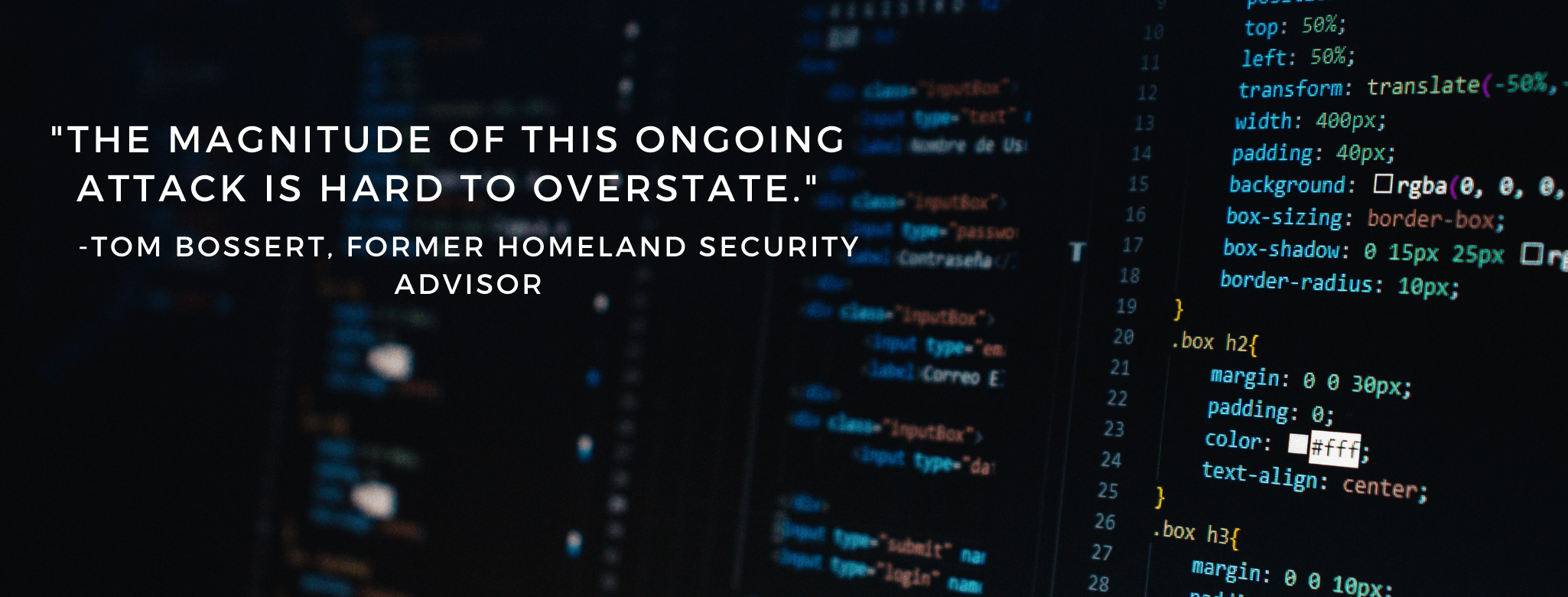
It is difficult to say exactly how destructive an attack like this is. As of now, many US government organizations have been breached: the state department, the treasury department, homeland security, the Los Alamos and Sandia National Laboratories (where nuclear weapons are developed), the National Nuclear Security Administration, the National Institutes of Health, and many more which are being revealed hourly and daily. Tom Bossert, the former homeland security advisor, said this week in a New York Time op-ed, that “the magnitude of this ongoing attack is hard to overstate, and demands a swift, decisive response in which all elements of national power must be placed on the table.”

Cyber attack

The last 12 months have made it abundantly clear that cybersecurity should be the number one priority during personal and corporate internet use, and the last week has made it equally clear that not all cybersecurity tools are created equally. Over the past several years the US has invested billions of dollars in Einstein, a system designed to detect digital intrusions. But because the SolarWinds hack was what is known as a “supply chain” attack, in which Russia compromised a trusted tool rather than using known malware to break in, Einstein failed spectacularly. The government cannot say it wasn’t warned! A 2018 report from the Government Accountability Office recommended that agencies — and federal defense systems more broadly — take the supply chain threat more seriously. It is vital that the tools that you and your business use are sophisticated enough to detect the threats supply chain attacks present.

Safernet vpn

SaferNet is the perfect solution to the cybersecurity issues that individuals, families, and businesses face today. It not only connects every device using a secure, 24/7 always on, military grade VPN, but it also stops outside cyberthreats, malware and viruses as well. On SaferNet, all users are protected anywhere in the world, all the time, on any cellular or Wi-Fi network. In addition to SaferNet’s VPN and cyber protection, it also offers a range of employee or parental/family internet controls including internet filtering, monitoring, scheduling, and blocking access to websites or even entire website categories

Typically, a business or family would need 3 separate services for a VPN, Malware Protection, and Internet Controls; SaferNet offers all 3 features in one service. SaferNet truly is an endpoint security presence that can be implemented in minutes around the world, on phones, laptops, tablets, and computers at an economical price point that caters to all sizes of businesses and families. SaferNet guarantees a smooth setup and installation process that takes only minutes, and an easily accessible control hub for you to monitor all your employee’s or family members devices; including activity, time spent online, and threats blocked.

SaferNet’s VPN+ Aims To Revolutionize Cyber-Safety

SaferNet is revolutionizing cyber-safety. SaferNet’s (VPN+) app provides privacy, protection and control of the internet for all end point devices anywhere in the world. Below is our recent interview with Brad Hawkins, CEO of SaferNet:


Q: You call yourself a (VPN+) app. What is the difference between a VPN and a VPN+?

A: Experts say that to truly be safe online, everyone needs to be diligent about using cybersecurity, and recently, they have been saying it is critical to be using a Virtual Private Network or VPN. Also, the experts often say these tools alone are not enough. We need to be wise and diligent not to do things online that create more risk. SaferNet has solved this issue by combining all the crucial cyber-safety tools together into one app.

Our VPN is designed differently than many VPN’s currently offered in the market. Our VPN is a 256-bit encrypted VPN; the same level of encryption used by the military and banks to ensure safety and privacy. But that is only part of what makes our VPN special. One of the negatives of a regular VPN is that it must be activated every time a device is turned on. Sometimes people either forget or get lazy and do not go through the process of setting up their VPN every time they get online because it is cumbersome and often takes more time than the user thinks it’s worth. This is usually when something sinister happens and often without their knowledge. Our VPN is a 24/7, always active VPN. Once SaferNet is set up and the VPN is active, our users can forget about it because the VPN automatically engages every time, they turn on their device and they are always protected whether they are using wifi or on any cellular network around the world.

The second part of our (+) technology is protection. We can protect our users from accessing sites on the internet that deliver all those pesky viruses, ransomware and malware that cause so many issues.

The third part of the (+) technology is our incredible internet controls. Accessing the internet without using internet controls is like driving with no safety laws in place. There are so many sinister strategies that malicious internet users use to access your devices or even worse your kid’s or employee’s (people that you are responsible for) devices. Something as simple as a deceitfully placed add can take one’s device to sites on the internet that an administrator might find offensive or a waste of time or even worse, to a hacker’s access site. It is easy to wind up in places that are not of value to us when we are not paying attention. SaferNet keeps our users focused on what is important to the administrator.

SaferNet provides over 200 internet controls to give administrators a very simple and easy way to monitor and control the internet, and truly design the internets access for each device. We have 84 content category filters that allow you to pick what portions of the internet can or cannot be accessed by a device. You even can allow or block specific websites. You can use this if, for example, you would like to block all social media but allow Facebook for a specific reason. Or you might want to allow Facebook and Instagram for one person, or a group of people, but block social media for everyone else. You can also turn the internet on and off as you desire; manually or with a schedule. All Apps are now in your control as well. You can truly design how you want to use the internet.

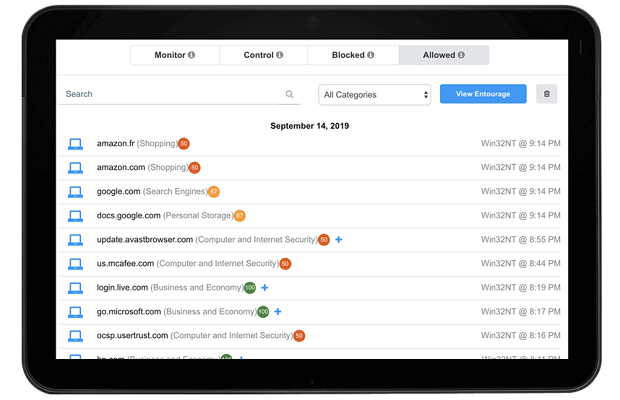
Visualizing the online activity is amazing to see. You can see every person’s device as well as the internet activity on each specific device; both what is being blocked and what is being accessed. SaferNet also protects you from “Entourage” and allows you to see the Entourage that is trying to access your devices. Entourage is what we call the incoming activity (or “pings”) to your devices that hit numerous times a minute from websites that you have previously visited. Before SaferNet, you were never able to see this type of activity. Some Entourage is harmless, but some may include malicious content, web advertising and other “tag-along” websites that typically represent unsolicited and unwanted content or attempts to scrape info off your device. SaferNet blocks all the unwanted and malicious Entourage on every device. This feature alone will make you a believer in SaferNet, and you will never want to access the internet without it.


Q: We often hear that digital privacy does not exist nowadays. Is that true?

A: Because we live our lives online there is no digital privacy anymore, but because of smart technology, it is bigger issue than people even realize. People might think that because they are not doing everything online that they have some privacy but that is simply not true. I was talking with a very successful marketing company recently, and they have a strategy that keeps track of 13,000 datapoints per smart device. This includes the route you take to work, the location you stop for coffee, what you buy at the coffee house and when you get to work. It also includes how long you spend at work and how often you take a break. I could go on and on. They are getting this information from tracking our devices, listening to us from our devices, tracking our GPS locations, and tracking dead times on the devices etc.

Often, I am surprised at people’s reactions when I share with them what is happening in the digital world. Some people think it is great because they get targeted ads for things they want to purchase. Others are resigned to the fact that it is a necessary evil and if they have nothing to hide, what does it matter? Many are appalled and do not believe that anyone should have that kind of knowledge about anyone else. How would you feel if you hired a plumber to come to your house to do some work, and while they are working they invite their cousin, their kids, their neighbors that just got out of jail and anyone else they can think of over to your house. While the plumber is working, all the “Entourage” is going through your drawers, cabinets, filing cabinets, storage, garage, your car, and your secret hiding places without your knowledge. You have no privacy. They do not take anything, but they go through everything taking pictures and notes on all that they see. Most people would find that creepy and unacceptable. My question is, why do we allow that kind of behavior on our devices and with our digital footprint?

This is a very big reason why we created SaferNet. Privacy is critical.

Q: What can we expect from your company in the future?

A: SaferNet has been working hard on developing one of the first IoT cybersecurity devices ever seen in the market. Our SaferNet 360 product will be able to provide cybersecurity and privacy for all IoT devices using VPN connectivity.

An IoT device is anything that connects to the internet that is not a “Smart” computer. Examples of IoT are gaming systems (Xbox), security cameras, printers, baby monitors, refrigerators, etc. These types of devices are wide open to the internet and are the easiest to access for hackers. Typically, they are not protected because they do not have a motherboard, so you cannot download any type of antivirus or cybersecurity on these devices. We are just finishing the testing on our 360 product that will connect to your router and capture and protect all IoT traffic. We will provide the same protection and controls for all the IoT devices as we offer now for mobile/smart devices. We are very excited about what this will do to protect the wide-open world of IoT devices.


This article was previously published on Tech Company News at: http://techcompanynews.com/safernets-vpn-aims-to-revolutionize-cyber-safety/

SaferNet’s Learning Community

Parents, SaferNet is asking you to come forward and become a part of a really exciting learning community that we are starting to grow. The purpose of this learning community would be to unite you with other parents and share your experiences with parental controls, internet safety, and parenting in general.

We understand the struggles of being a parent, a good majority of us at SaferNet have more than 1 child, so we know what it’s like to maintain parental controls and internet safety with multiple children. SaferNet is able to take away some of the frustrations of being a parent day-to-day, and we’d love to hear your feedback on our product, how you use our product, and connect you with other SaferNet parents!

As of now, SaferNet invites you to get involved in our movement by Liking, Following, and Sharing our content on our social media accounts. You can even use the hashtag #SaferNet to communicate with us and other parents on social media if you’d like! Also, be sure to subscribe to our monthly newsletter that will be emailed to you on the 15th of every month with news & updates about SaferNet.

We believe that parents can learn from each other and create something fantastic for other parents to get helpful tips and guidance for all kinds of situations. Parenting will never be as easy as a walk in the park, but we strive to create a product that will suit every parents’ need.

We truly care about the safety and well-being of your children, and highly encourage you to get involved in any way you can and become a part of a very special community where our children’s internet safety is always the priority.

Let us know what kind of things you’d like to see from us on this subject!  http://safernetvpn.com/

Cyber Threats – What’s An Entourage and Why is it Dangerous?

It’s no secret that advertising is everywhere, and unavoidable. However, advertising to your children is a market that has been brought to light recently. “It is estimated that advertisers spend more than $12 billion per year to reach the youth market and that children view more than 40,000 commercials each year.”

$12 BILLION.

No wonder there are so many ads on your kids’ favorite apps, or even when watching their favorite show on TV. Advertisement isn’t necessarily a bad thing amongst adults, if they’re educational enough about a product you might consider buying at a grocery store for example, you might go out and buy it. But the impact advertising has on children is absolutely unacceptable.

A couple example of this are:

  • Advertisements on children’s apps with inappropriate or offensive content
  • Manipulative advertisements for junk food with the intent of targeting children
  • Advertisements for alcohol, marijuana, and cigarettes that are targeted to today’s youth

Unfortunately, with almost any app you can get in Google Play or Apple’s App Store, advertisement will always be there.

The disturbing part of it is that younger children can’t differentiate when a game for example, leaves and the advertisement starts, and it takes 20-30 seconds for an X to pop up and turn off the ad.

But children that young don’t know they’re seeing an ad, and think it’s part of the game, so they keep watching and absorbing this information blindly.

Now, for parents that already use SaferNet, we have a list called an “Entourage” that you can get to in your profile. An entourage is essentially a list of websites in your network that track your IP address and try to find you and advertise to you. These are dangerous especially in the example that that someone using your IP address was looking inappropriate content, and they’ve now tracked you and start advertising to your family about this content. And then what happens? A toddler accidentally clicks on violent pornography advertisements. For people that don’t use SaferNet, there could be potentially hundreds of websites tracking your IP address and bombarding you with targeted ads.

The bottom line is that our kids’ activities should be kept as innocent as they are, and we strive for their safety and well-being at SaferNet.

One of our main features is blocking ads. They’re not only annoying, they’re potentially dangerous on a scale of identity theft. Our VPN technology protects against malware, botnets, ransomware, etc. that could be hidden in an advertisement trying to get your personal information. Imagine letting your child play with an app on your phone and they’ve opened an ad and started using your Google Wallet account? Now the person on the other side has your whereabouts and bank information. How scary is that?

Check out SaferNet’s features and start protecting your children today for $7.99/month: http://safernetvpn.com/pricing/

Anywhere Protection – Keeping Your Kids Safe Outside of Home

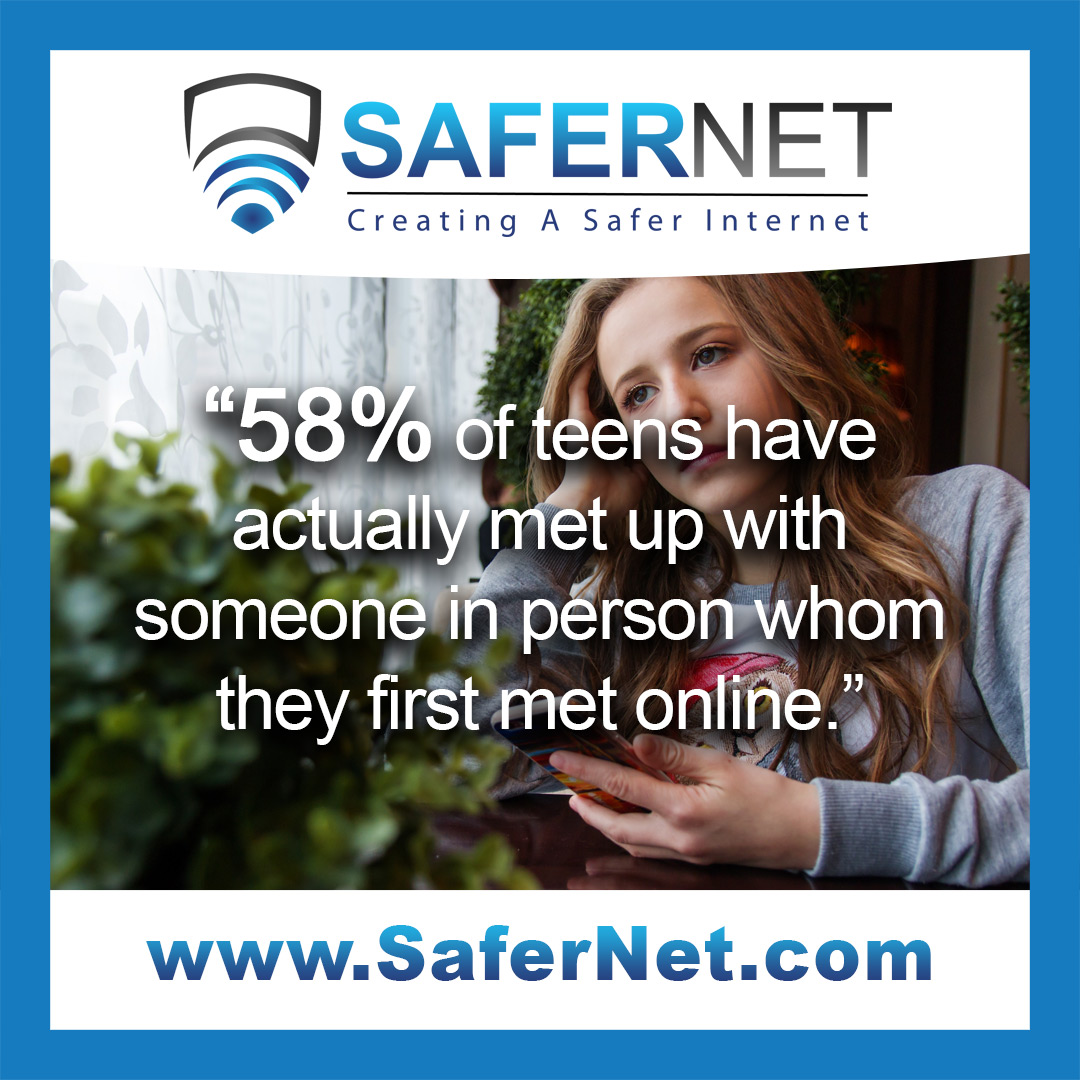
It’s no lie that kids are constantly put in danger daily due to the use of online chats with strangers. Unfortunately, the statistics of children and teens meeting up with strangers from the internet are going up, and the percentage of children sharing this information with their parents is not just going down, but almost non-existent. The result of not taking internet precautions with your children can end up extremely severe, such as this case:

“A 23-year-old man has been detained on a range of criminal charges in Florida after allegedly driving more than four hours to kidnap and sexually assault a 10-year-old girl who was found cowering in a hotel bathroom with a pink dog collar around her neck, PEOPLE confirms.”

This article also confirmed:

“Law enforcement was notified the victim was missing after a note was found on her bed, saying she would be staying at a friend’s house for the next three days. Investigators examined her electronic devices and discovered disturbing exchanges she’d allegedly had with Fundora.”

She was found, and brought home safely to her parents. But the cold hard truth is that not all of these cases end with the victim being safe.

“A community is grieving the loss of 12-year-old Naomi Jones. The would-be sixth-grader was missing for five days before her body was found Monday. An Alabama man who is a registered sex offender has been arrested and charged with kidnapping, homicide and disposing of her body.” –  NWF Daily News

Absolutely tragic. A good majority of parents overlook the potential dangers of the internet because of not thinking big enough. A common phrase you’ll hear is “I raised my kids better than that, they know they can be honest with me”, and because it feels like an attack on their parenting and how they raise kids, the real problem is masked.

We’re not saying to not trust your own children, but we are saying you can never be too cautious with your child’s safety. The best way to be build trust with your child is to address the issue and take precautions, if your child is not willing to be safe for their own well-being, then sit down and have a talk with them on why it’s so important. Education is the best prevention against these horrifying cases involving internet predators and pedophiles.

Not only does SaferNet enable the ability to block websites that can potentially harm children, but it also has the ability to block the use of incognito tabs. If you’re not aware of what those are, incognito tabs are a private browsing window that doesn’t hold any history and can be closed instantly. You may not even be aware your kids use that to browse privately at things they don’t want to address with you the parent, or browse through websites they know they’re not supposed to be on, or even worse; talk to internet predators.

Prevention of these horrible incidents with children is SaferNet’s priority. Who wouldn’t want their children to be safe? Talk to your kids, install SaferNet, and never have to worry about your child’s safety on the internet again.

Sextortion – The New Blackmail Spiraling Out of Control

Amanda Todd was like every other 15-year-old teenage girl. She wanted to make new friends online. The friendly chats went a bit further when one of her friends asked her to show her breasts on camera. This is when Amanda made a mistake – complying to the request of an “online friend” she had never met in person. Not long after, she began to be blackmailed by that person demanding more revealing images of herself and a “performance” lest her image be circulated amongst friends and family. The threats escalated and when demands were not met, the image was circulated all over the web. A never-ending experience of taunts, humiliation, and cyber bullying culminated in Amanda being unable to bear the pressure and eventually committing suicide. As sharing sexts become common among teens, cases of sextortion (forcing someone to do sexual favors by threatening to leak naked pictures of the victim online) and blackmailing for money are spiraling out of control. The FBI admits that the crime has reached unprecedented levels and it’s becoming increasingly difficult to keep up with the cases.

As sexting becomes a trend, children are putting themselves at risk. Online predators posing as young kids entice boys and girls to share nude images and later blackmail them.

Sextortion is not just limited to girls as boys are increasingly becoming the targets of this. A whole crime syndicate in Philippines targeted boys across the world by using social media. They then entice them to use video calls to engage in cybersex. Using pre-recorded videos of girls undressing, boys are enticed to do the same. Unsuspecting boys are then recorded and blackmailed for money. All victims, be it boys or girls, give in to the demands of the predator (be it giving money or meeting his perverted desires) in the hope that the blackmailer won’t circulate their images or videos online. And all are too embarrassed to share the problem with parents and approach the police making it more difficult to catch the criminals. Lesson for Parents: Win Child’s Trust Children are not speaking up. Embarrassment and fear of punishment is holding them back. As kids, they can’t always be trusted to make the right decisions. One mistake and they tend to cover up by making more. All this time they are bottling up shame and fear inside. One FBI special agent advices parents to talk to their children and let them know if they come forward, they are not going to suffer any punishment or ramification. Parents of sextortion victims wish that their kids had come to them earlier and told them the truth before it got so big. Talk to your kids like a friend and assure them that you stand with them, no matter what.

Keeping Kids Safe Online: 5 Things Parents Must Do

Besides having an open dialogue with children and making them aware of dangers online, you must put into implementation these 5 things for added safety:

Keep Your Devices Safe

First things first. Safer your devices, safer your kids are going to be. Anti-virus software’s are incapable of detecting advanced malware attacks. A Wi-Fi security solution will offer full protection. No possibility of malware attacks, ransomware attacks, phishing, and several other cybercrimes. For instance, WideFi blocks all threats in real time keeping your devices safe from any malware or other threat.

Block Adult Content

Block all possible websites and content that lure your kids into the murky world of internet. WideFi offers parents a “Remove Adult Content” feature that makes online browsing much less dangerous.

Keep a Check on Child’s Activity

Although it is a time-consuming task but do keep checking your child’s online activity at intervals – websites visited, apps visited and how long they spent on those. That ways, you can come to know if your kids are logging into chat rooms and other potentially dangerous platforms. WideFi offers this powerful feature too.

Own a VPN

Say goodbye to identity theft and hacking threats by owning a Virtual Private Network (VPN). A VPN provides a secure environment within the internet and encrypts all information that passes through it making your data safe from hackers. WideFi lets you have your own Virtual Private Network and fend off online predators.

Lay Ground Rules

No online surfing during family time, lunch time and bed time. Besides ensuring that kids are using internet in a healthy way, it also gives family more time to share their day’s events. The more time the family members give to each other, more the chances that children will share school incidents and online experiences with you. If this becomes a practice, then kids will share unpleasant experiences too. WideFi assists parents in this task too. It offers parental controls “Family Time”, “Time Outs” and “Bed time” thus letting you control internet usage with click of a button.

SaferNet offers innovative new Wi-Fi Security Solutions for Home & Business.

Ultimately, the most powerful tool in protecting kids lies with you – Prevention through Education. You can’t spy 24/7 on your kids. But you can make them prepared for dealing with any unpleasant encounter. Also remember that your children won’t always become the victims, they can be the bully too. Sensitize them as to how labelling others or commenting in bad language can hurt others’ self-esteem. If they’re on the receiving end of cyberbullying, they must learn not to react as that is exactly what the bully is looking for. Last but not the least, make them believe that they can always share “anything” with you and you won’t judge or reprimand them. Sorry parents but the buck stops with you. For you are the guardians of their galaxy –real and online! P.S. SaferNet is the only wireless network security software that is 100% cloud based. That means, you don’t have to break a sweat in installing any hardware. Protect Your Kids with SaferNet.

Careful What Those Little Eyes See!

Parental Control Is Not An Option Anymore.

Doggy.

Your 6-year-old innocently types this word on Google hoping to get nice, cute images for her project. Yes, those cute, fuzzy canines with their heart-melting eyes pop up on the screen entertaining your child for several couple of minutes. Videos make her even happier. “But hey, what’s this video? Let me see” and the child is horrified to see a naked man and woman doing something that he or she can’t make any sense of!

There are hundreds, in fact thousands of such cases, where children are exposed to pornographic content accidentally. According to FamilySafeMedia, 90% of 8-16 year olds came across porn online while doing homework!

Porn is just one part of disturbing content filling up the internet for your children. There are far more dangerous types of content that your kid should never ever stumble upon, even when they’re teenagers.

Harmful Content You Must Protect Your Child From:

  1. Websites that show self-harm and drug use
  2. Websites that encourage eating disorders (anorexia and bulimia)
  3. Websites and blogs that show the efficacy of different methods of suicide
  4. Videos showing abuse, violence and cruelty to animals
  5. Violent video games
  6. Videos of beheading of people
  7. Material that encourages racial hatred, homophobia and misogyny
  8. Internet Pornography
  9. Foul Language Use

These 9 categories don’t cover all the disturbing content proliferating on the web. Children, especially older teens, are getting exposed to stuff we can’t even imagine. And to think why teens getting addicted to drugs, pornography, or suffering from mental and eating disorders!

We don’t mean to scare the parents reading this (but we probably will, because we’re scared too). But a blanket ban on kids going online is as good as not letting them go out on the street for who knows which predator is roaming the street at the same time. In an interesting article “The Loss of Childhood” published in the New York Times, the writer states, “The Age of Protection has ended. An Age of Preparation has set in.”

However, there is a need for protection like never before. Online predators, posing as young kids, are befriending gullible children, purposefully exposing them to pornography, or pressurizing them to share nude pictures of themselves so they can sexually exploit or blackmail them later (called sextortion). But how can you protect your kids from all this danger?

Protecting Your Kids From Adult Content:

It’s unlikely that a tween (kids between the ages of 5 and 12) would seek or come across such dangerous websites as illustrated above. But they do stumble upon sexually explicit content by typing innocent words in a search engine. A search on popular cartoon characters and pop singers often produce links that feature adult content.

According to a study by FamilySafeMedia, the average age of first internet exposure to pornography is just 11 years old. No, it’s not alright for such a young kid to be watching porn, whether accidentally or by intention. There’s nothing wrong with sex; there’s plenty wrong with porn. Here’s a list of reasons why:

How Early Exposure to Porn Affects Your Child:

Gone are the days when kids’ exposure to pornography was limited to Playboy and Penthouse magazines stashed under the mattresses. Now, it is all over the web, available 24/7 at the click of a button. The addictive nature of consuming pornography affects kids more than we can imagine.

  1. Anxiety & Shock- Kids exposed to sexually explicit content at a very young age experience anxiety and shock. Kids are not mature enough and the unfamiliar bodies engaging in those acts frighten them. Children also report feelings of disgust, shock, embarrassment, fear, and sadness after viewing the content (Manning, Jill, Sexual Addiction and Compulsivity, 2006).
  1. Early Sex- According to a research by Elysia Walker and Dr Emily Doe from the University of Buckingham, exposure to sexually explicit material at a young age increases the likelihood of sexual behavior at an earlier age. The research revealed that for respondents, the first exposure to explicit content began at 12 years old and they initiated sexual behavior around a year
  1. High-Risk Sex- Frequent exposure to pornography is associated with multiple sexual partners and use of alcohol and drugs during sexual activity (Braun-Courville, D. and Rojas, M., Journal of Adolescent Health, 2009).
  1. Sexual Violence- Children under 12 years old who have viewed pornography are statistically more likely to sexually assault their peers. A child advocacy group interviewed 70 child sex-abuse victims and found that most of the predators were other children who were acting out the violent pornographic material they saw online. An officer’s statement is unbelievable to our ears, “We had a case recently where the victim is only 3 years old and the perpetrator is only 10 or 11 years old.”
  1. Sexting- Pornography is also leading to the dangerous trend of “sexting” as young girls are increasingly feeling the pressure to share naked images of themselves online (Van Ouytsel, , Ponnett, K., and Walrave, M., 2014).
  1. Gender Stereotypes- Most pornographic content is degrading to women and shows woman as submissive and men as aggressive. This leads to unhealthy perceptions and attitudes towards women who are “shown to enjoy sexual ”
  1. Porn Addiction: Thanks to the easy accessibility of porn and the desensitization effect, kids are increasingly getting addicted to it. According to a survey by NSPCC ChildLine, 10% of 12-13- year-olds are worried that they are “addicted” to

Studies are unearthing many more disturbing findings and correlation between porn and psychopathology. Porn isn’t the only thing that is upsetting kids. According to a news report by Guardian, children are as upset by violent videos on YouTube that feature animal cruelty or beheadings. That brings us to…

Kids and Violent Video Games:

Do playing violent video games make children violent? This question has been asked by many concerned parents who saw their kids passionately gun down people and steal cars in the name of fun. Academia has rigorously tested this proposition with mixed results. The debate has been raging for years and refuses to die down.

Recently, President Trump called a meeting to find a connection between mass shootings in school and violent video games. This might seem far-fetched to many but incidents like 2016 shooting in Munich, Germany, where the 18-year-old shooter was found to be a fan of first-person shooter video games concerns. ABC reported an incident where two teenagers in Tennessee shot at passing cars and killed one driver. The teens had got the idea from playing Grand Theft Auto III.

These facts are eye-openers for all of us: 90% of children in the United States play video games (Source: American Psychological Association). The number rises to 97% for kids between the ages of 12 and 17. More than 90% of video games involve mature content including violence.

Impact of Violent Video Games on Kids:

  1. Fear- Children, especially tweens, who are not mature enough to distinguish reality from fantasy, can get disturbed by violent content and come to perceive the world as a violent, scary
  2. Increase in Aggression and Violent Behavior- Children imitate what they see, as the famous Observational Learning Theory points out. Studies prove this further. In a randomized experiment, researchers Irwin & Gross found that boys who played a violent video game showed more physical aggression towards peers (e.g., hitting, shoving, pinching, kicking) as compared to boys who played a non-violent video
  3. Desensitization to Violence- Amongst teens and young adults, repeated exposure to violent content can make them desensitized towards it. Researchers Carnagey, Anderson and Bushman found that young adults also show physiological desensitization to real-life violence, as measured by less of an increase in heart rate and skin
  4. Lower Empathy and Compassion- According to American Psychological Association, exposure to violent video games is associated with lack of empathy and kindness. Researchers Bushman and Anderson found evidence to support this. They found that individuals who had played violent games, compared with non-violent, were less likely to report hearing a fight staged outside the laboratory, judged the fight as less serious, and were slower to respond when asked for
  5. Impact on Brain- Neuroimaging research is now showing us how media violence is affecting kids’ brain development. For instance, one research has found that teens exposed to violent video games experience a decrease in activity in their prefrontal cortex, which is associated with problem-solving and controlling of emotions (Tom A. Hummer, 2015).

For reasons of brevity, we are not citing all studies related to kids and violent video games here. But this much is firmly established that playing violent video games is a powerful risk factor. Violent behavior in children is a combination of many factors, such as violence at home or in neighborhood, socio-economic factors, the child’s personality, and exposure to media violence.

The growing popularity of Mature-rated (M-rated) games and depiction of sexual violence towards women in some games should make the parents be cautious of what games their kids are playing online.

Parental controls can help you monitor their online playtime.

Kids and Self-Harm Websites:

According to a study published in the journal Pediatrics, an estimated 14% to 24% youth and young adults engage in non-suicidal self-injury such as cutting. Focusing on YouTube, world’s most popular online video community, researchers searched for content on “self-harm” and “self-injury”. The team identified top 50 videos that showed a live person and top 50 videos that showed words and visual elements. All 100 were viewed more than 2 million times!

How can you forget the panic that the infamous game Blue Whale Challenge recently created as kids jumped from buildings to their death to complete the challenge! The suicide game targeted teens using social media platforms like Facebook, Twitter, and Instagram asking players to participate in 50-day challenge, ranging from dangerous tasks to self-harm and eventually suicide.

Another reason why parents should keep a track of what their kids are doing online, how long they’re spending on Internet, and what they’re downloading. It’s necessary we repeat this- get a Wi-Fi security software to ensure safe internet for your kids.

Kids & Pro-Anorexia Websites:

Young girls (or even boys) infatuated with thin bodies are at a great risk of visiting websites and joining forums that support eating disorders like anorexia and bulimia. The creators of these sites and forums are themselves suffering from these eating disorders and encourage others to proudly embrace their condition “not as a disease but a lifestyle” and as “a quest for perfection”. And these websites are getting thousands of hits daily!

An estimated 11 million Americans suffer from anorexia or bulimia (Source: Time.com). A survey of adolescent anorexics and their parents conducted by Stanford University School of Medicine revealed that 39% of the kids were visiting pro-anorexia forums.

Terms like pro-ana, pro-mia, or just ana, and thinspiration constitute the lexicon of this community. Their “Thinspiration” galleries are full of stick-thin models and actresses. The encouragement by fellow anorexics to starve themselves, purge, eat less than 50 calories a day, etc. is making the problem even worse.

Parents should not only report such websites to help them get blocked but also get them blocked on their network using Parental Controls. After all, your child may stumble upon such a website while surfing fitness tips. Secondly, track the websites your kids are using and if you find them spending too much time reading stuff on losing weight, extreme diet control, and fitness tips, it’s time you have a talk with your kid about “ideal body” and “healthy diet.”

Avoid these potential dangers with SaferNet. Learn more about our features here.
Social Media Guide for Parents: Take the Matter Into Your Own Hands

Thanks to your consent (or none), the kids are on social media. How do you know if they’re accessing an adult website or not? They might be clever enough to delete history. A bigger concern – are the devices being used by you and your children safe from external threats? Take the matter into your own hands by securing your cyberspace from any kind of threat:

Protect Against Cyber Attacks

Smart home devices are increasing at an unprecedented rate. So is the threat of cyber-attacks and malicious activities. An estimated 60 -70% of all wireless networks DO NOT use any type of encryption and are thus vulnerable to security threats. 90% of connected devices store personal information (Source: TechGenix, 2005). No wonder there’s a new victim of identity theft every 2 seconds (Source: Javelin Strategy & Research)!

There is no stopping cyber-attacks. But you can stop them attacking your home!

No, a commercial antivirus software is not the solution. 55% of cyber-attacks go unnoticed by them (Source: The Guardian). You need a wireless network solution to have 100% security. SaferNet is a cloud- based Wi-Fi security software which creates a protective shell around your home’s IoT ecosystem, ensuring that not only your devices but your kid’s data is secured. SaferNet’s user-friendly dashboard shows all threats that are blocked in real time.

Even better, SaferNet lets you have your own Virtual Private Network (VPN). If you don’t know what a VPN is, it is a service that secures your internet from hackers trying to steal your information or redirect you to fraud websites.

Block Adult Content

Porn is a big concern for every parent. Children are getting exposed to pornography very early, some as early as 6 years. Even if children don’t go finding porn, porn finds them. A click by mistake, a pop-up ad, a video on social media timeline – there are many loopholes from where objectionable content can manifest on the child’s screen. Do we even need to say they need to be blocked? Duh!

Monitor Excessive Usage of Social Media

Social media risks are not always as big as sexting, cyber-bullying, sextortion, or pornography. Small aspects such as excessive usage of social media can have a significant impact on your child’s health, sleeping pattern, eating habits, and psychological well-being. There are many studies finding disturbing relationship between Facebook and depression among adolescents, social media and eating disorders. Regulate this usage by fixing the number of hours your kids can use internet.

If both the parties have agreed to 2 hours being the maximum time, let SaferNet automatically disable internet after that time. Obviously, you can’t be standing over your child 24/7 to count their usage!

SaferNet’s internet security solution offers easy to use Parental Controls “Family Time”, “Bed Times” and “Time Outs”. Its intuitive interface lets you monitor the internet usage, disable devices, block apps, and evaluate the current status of malware viruses being filtered out on a daily basis – all with clicks of a button on your mobile phone. In short, SaferNet promises to be your kids digital parent!

Control Apps, Websites and Content

Your kids are much smarter than you think, at least digitally. They know you check their smartphones regularly to see which apps are installed and browse their activity. A recent Colorado sexting scandal revealed use of photo vault apps that hide nude pictures by appearing to be a media player or a calculator. You need to be one step ahead of your children or be as smart. Know what your kids are doing online – apps visited (past and present) and applications visited (past and present) with a Wi-Fi security software.

Know what, when, where and how your home network is being used with SaferNet.

There are many home network security devices in the market. SaferNet is the only solution which is 100% cloud-based. No hardware installations! Not any. Every online activity and safety measure can be accessed with the click of a button on your device. And it is not just devices at your homes that we safeguard, we help secure a business network too.

Ensuring a safer internet for your child is not the responsibility of government and cyber cells alone. They aren’t safe in the first place. Take the matter into your hands starting today!

P.S. We would love to know your thoughts on social media age restrictions for children. When did you let your child join any of the social networking sites? Any advice for other parents? Post your comments in the box below.

Explore SaferNet’s Wireless Security Solutions for Home & Business


Parental Control Tips for Parents

Happy National Cyber Security Awareness Month! SaferNet is sharing our best parental control tips with you to ensure the safety of your children. Consider this:

  • 67% of teenagers say they know how to hide what they do online from parents (Source: Pew Research Center).
  • 10% have unlocked parental controls to disable filtering (Source: Pew Research Center).

Children are getting smarter. Stay one step ahead by using SaferNet security software and exercising these parental controls Block/Filter Content: Block adult websites using SaferNet’s “Remove Adult Content” feature. The search results will automatically filter out any inappropriate content be it pornography or graphic violence. SaferNet helps you outsmart your tech-savvy kids bent on disabling all filters.

  • Filtering Across All Devices- Whether your kid uses a desktop, laptop, iPad, or a mobile device, parental controls are automatically applied to all.
  • Filtering Across All Browsers- There are plenty of browsers like Internet Explorer, Google Chrome, Mozilla, Firefox, Safari, Opera, etc. Children can install a new one to override parental controls. But with SaferNet, no such luck. Kids can’t change settings without the parental control password.
  • Filtering Across All Search Engines- Whether your kid uses Yahoo, Google, Bing, or Duck Duck Go, your children get filtered results. Child Safe Internet is now possible!

Monitor Online Activity: Know what your kids are doing online, how much time they spent, and how much data they have downloaded. Be aware of the apps and websites they have visited (past and present). Even if children delete their browser history, you are always aware of what websites your kids are visiting. Control Web Usage: Also restrict the amount of time kids can spend online. Use parental controls – “Family Time”, “Bed Time” and “Time Outs” to ensure that kids do not get addicted to internet and children have time for offline activities, time for themselves, and family.

General Tips for Parents:

Parental controls are a must and will work smoothly where regulating the activity of tweens is concerned. But as they step into adolescence, there will be a natural curiosity in them to watch porn. Parental controls won’t go down well with them. In fact, the more you stop them from doing something, the more they’ll feel attracted to it. Adolescence and rebellion! We’ve all been there. But the world wide web, as it exists now, didn’t exist then. So, it’s a must that you educate your child and make them a responsible digital citizen so they won’t need as much parental control as they grow up. Here are a few practices that will help you achieve this:

    1. Talk About Sex: Parents dread this. But it’s better they come to know about this from you rather than the web.
    2. Draw a Line Between Right & Wrong: Why blame the internet for all evil? The hyper-sexualized media, especially television, will probably show your kid inappropriate content at a very young age. Do not skirt the issue but take it as an opportunity to show your disgust towards the material and discuss with your kid how those images are degrading and in bad taste. Your child will also develop a strong sense of morality and the ability to differentiate between good and bad.
    3. Set Cyber Rules: Hammer home the lesson that kids should never talk to strangers online, open spam email, share their personal information such as name, address and phone number. Also tell WHY they should not be doing this so that the child understands the gravity of all this. When they join social media, they should be instructed to keep the privacy settings to
    4. Make Them Aware of Online Dangers: Your kids should understand the consequences of bullying others or sending nude images of themselves known as “sexting”. Kids are impressionable, seek attention and often succumb to peer pressure. It’s important they understand that sharing inappropriate photos can be misused by online predators or even be circulated by friends. No kid wants to be a laughing stock or an object of ridicule in the school or on web. This threat alone will keep your child willingly away from

Open communication between parents and kids is the best firewall against inappropriate content and harmful websites. Your kids will come across disturbing content sooner or later. They should be prepared for it. Leave no stone unturned to let your kid know that they can always come to you if they come across disturbing content and that you will not scold them. Win their trust, teach them the right defensive strategies, but first safeguard your cyber world from all online dangers with parental controls and a security software! To know more about SaferNet’s wireless network security software and its features, visit our Features page here: http://safernetvpn.com/features/